Storybook home

Academic position paper

From Page to Presence

Storybook Film Studio as multi-modal story transformation, recognition and shared meaning-making: a research-adjacent framing across arts, design, education and legacy practice.

FormatStandalone position paper FramingExploratory, practice-led, non-interventionist PathwaysPersonhood, place, music, dialogue and memory

Abstract

This position paper examines Storybook Film Studio as an emerging arts, design, education and legacy practice concerned with the transformation of personal stories across media. Storybook began from a practical creative question: could a child's written story be given illustrations? In practice, that question expanded into a multi-modal process in which an original story may become visual identity, music, film, a premiere-style viewing experience and, in some cases, an archive for later return. The paper does not claim that Storybook is a therapeutic, educational, ecological or wellbeing intervention. Instead, it asks how such a practice might be understood in relation to existing research on authorship, narrative identity, family memory, multimedia learning, music and emotion, person-centred arts practice, place-based pedagogy and music education. Drawing on North's work on Companion Poems and personhood, Adams' research on cynefin, place, kairos and more-than-human pedagogies, and Beauchamp and colleagues' work on music education, learner voice, dialogue and technology, the paper proposes Storybook as a research-adjacent site for careful inquiry into story transformation and recognition. A synthesis model is offered: page -> image -> sound -> film -> premiere -> archive/reflection. The paper concludes by outlining possible qualitative, practice-led and participatory research directions while maintaining clear ethical boundaries around consent, representation, authorship and unsupported outcome claims.

Keywords: story transformation; authorship; multi-modal storytelling; creative practice; person-centred arts; cynefin; music education; digital storytelling; legacy; recognition.

Opening Vignette: From an Illustration Request to a Premiere Moment

The origin of Storybook Film Studio can be stated very simply. A child had written a story, and the initial creative question was whether that story could be given illustrations. It was a modest question, almost practical: could characters be made visible, could settings be imagined, could a page of writing begin to look like a story world?

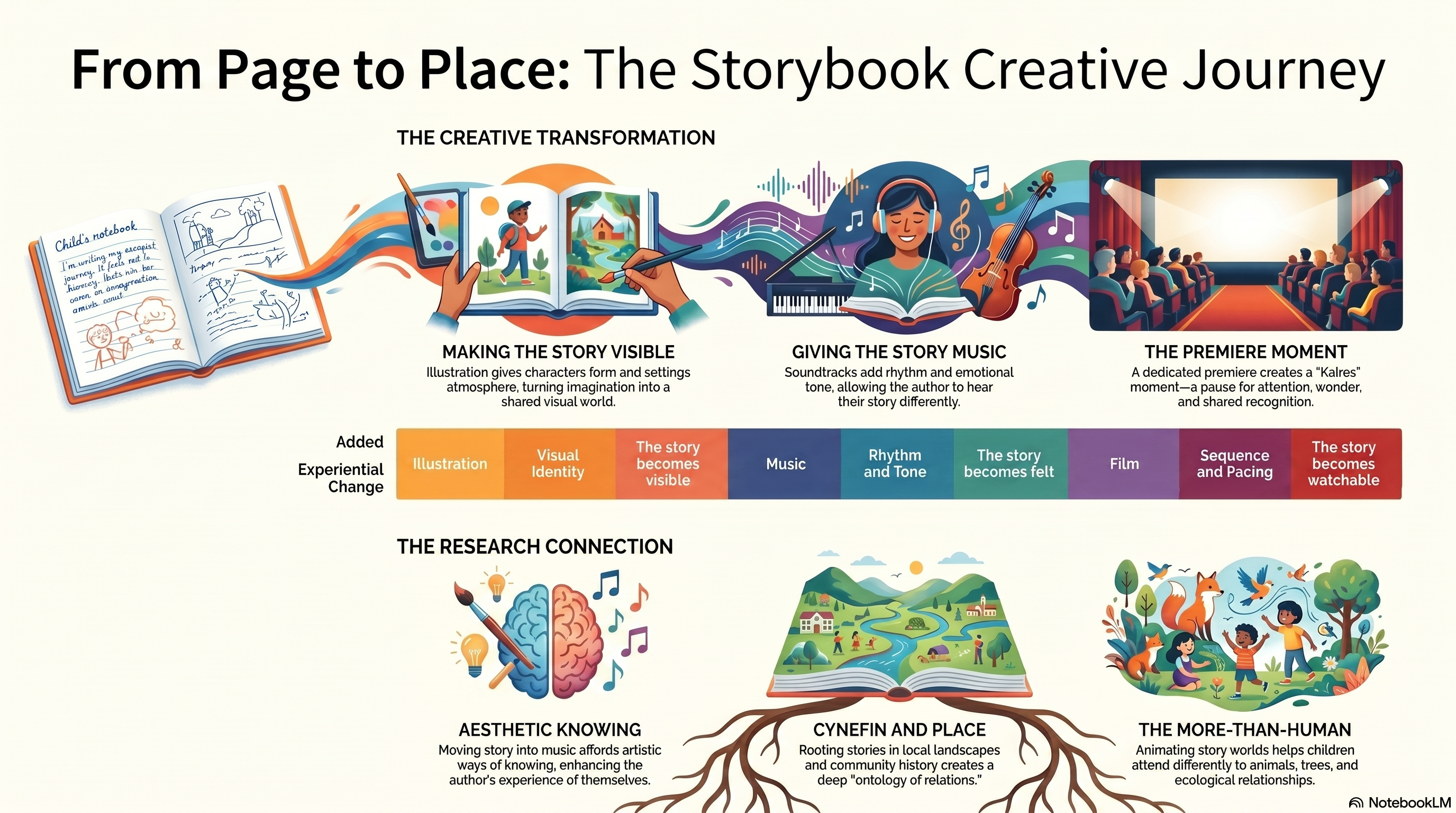
Yet the creative process did not stop at illustration. Once the story had visual form, another question emerged: what might the story sound like? Music added rhythm, mood and emotional contour. It allowed the story to be encountered differently, not as a replacement for the child's words but as another way of dwelling with them. Image and sound then suggested sequence, pacing and movement. The story became a short film. The film, in turn, suggested a premiere: a dedicated moment of shared attention in which the author, family or recipients could see the original story returned to them as something visible, audible and watchable.

Conceptual visual showing the Storybook journey from page to image, music, film and premiere.
Figure 1. From Page to Place: The Storybook Creative Journey. This conceptual diagram represents Storybook as a staged transformation from written story to visual identity, music, film and premiere. It is used here as a discussion model, not as empirical evidence.

This movement from page to premiere is important because it shifts attention away from technology as the central object. The software, image tools, audio tools and web page are not the primary claim. They are means through which a story can be handled, shaped and returned. What appears to matter most is the moment of recognition: the sense that a child, family member or older author sees their story treated as worthy of care.

The vignette offers the paper's central proposition. Storybook may be most usefully understood not as a finished media artefact but as a practice of multi-modal story transformation. Its significance lies in how it handles authorship, recognition and shared meaning-making across words, images, sound, film and social viewing.

Conceptual Framing: Authorship, Recognition and Multi-Modal Meaning

The first conceptual boundary is authorship. A personal story should not be treated simply as raw material for adult interpretation or technological production. In the case of child-authored work, this boundary is particularly important. Research on personalisation and digital story-making emphasises that agency depends on meaningful choice, contribution and control, not merely on inserting a child's name or image into a pre-existing template (Kucirkova, 2019). Storybook's ethical claim, therefore, cannot be that technology makes a story better. The more careful claim is that creative transformation should preserve the author's recognisable intention while extending the story into new expressive forms.

This connects with narrative identity and autobiographical memory. Fivush (2011) describes autobiographical memory as developing through social and cultural contexts, including family storytelling and elaborative conversation. McAdams (2001) similarly frames life stories as evolving constructions through which people organise meaning, continuity and purpose. Storybook operates in this narrative territory, but it must not overstate its effects. A film cannot guarantee identity development, memory formation or family connection. It can, however, become an artefact around which such conversations may occur.

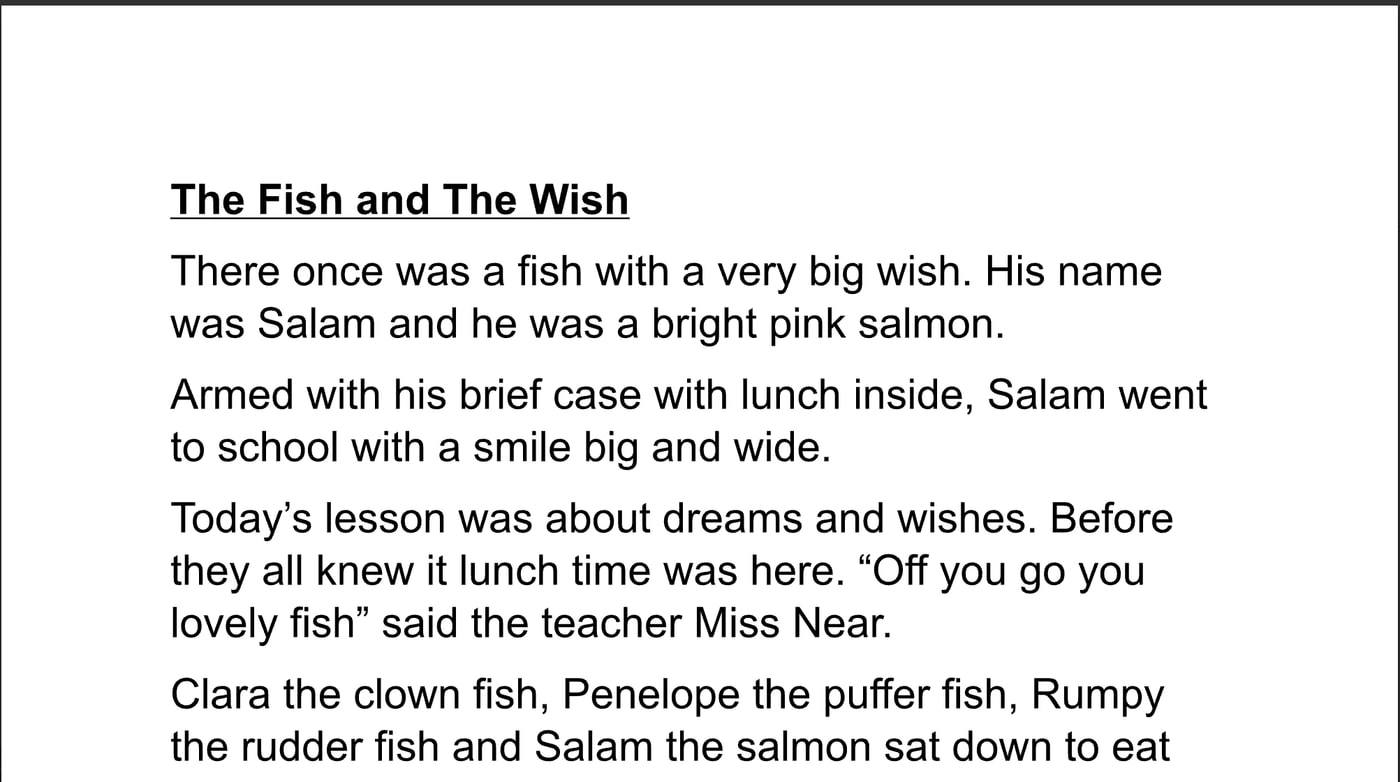
Original manuscript page used as a Storybook source text.
Figure 2. Original story material before transformation. The source text matters because it anchors the process in authorship. The figure is included to illustrate the paper's argument about preserving the originating voice.

The second boundary is recognition. A story film may communicate that a story has been taken seriously, but such recognition is not automatic. It depends on the quality of attention given to the source material: whether character, tone, pacing and emotional meaning are carried through rather than smoothed into generic content. Digital storytelling literature has long emphasised the importance of voice, consent and personal meaning when combining image, sound and sequence (Hardy and Sumner, 2014). Storybook's practice sits near this tradition while also differing from more participatory forms of digital storytelling because much of the technical transformation may be carried out by a creative producer rather than the author alone.

The third boundary concerns multi-modal coherence. Dual coding theory suggests that verbal and non-verbal systems can provide complementary routes for understanding and recall (Clark and Paivio, 1991). Multimedia-learning research similarly stresses coherence: additional media can support meaning when relevant, but can also distract or overload when poorly aligned (Mayer and Moreno, 2003). Takacs, Swart and Bus (2015) found that story-relevant multimedia features in technology-enhanced storybooks may support comprehension, whereas incongruent features may interfere. These findings do not prove that Storybook films improve learning. They do provide a useful design principle: every visual, musical and cinematic decision should serve the story rather than compete with it.

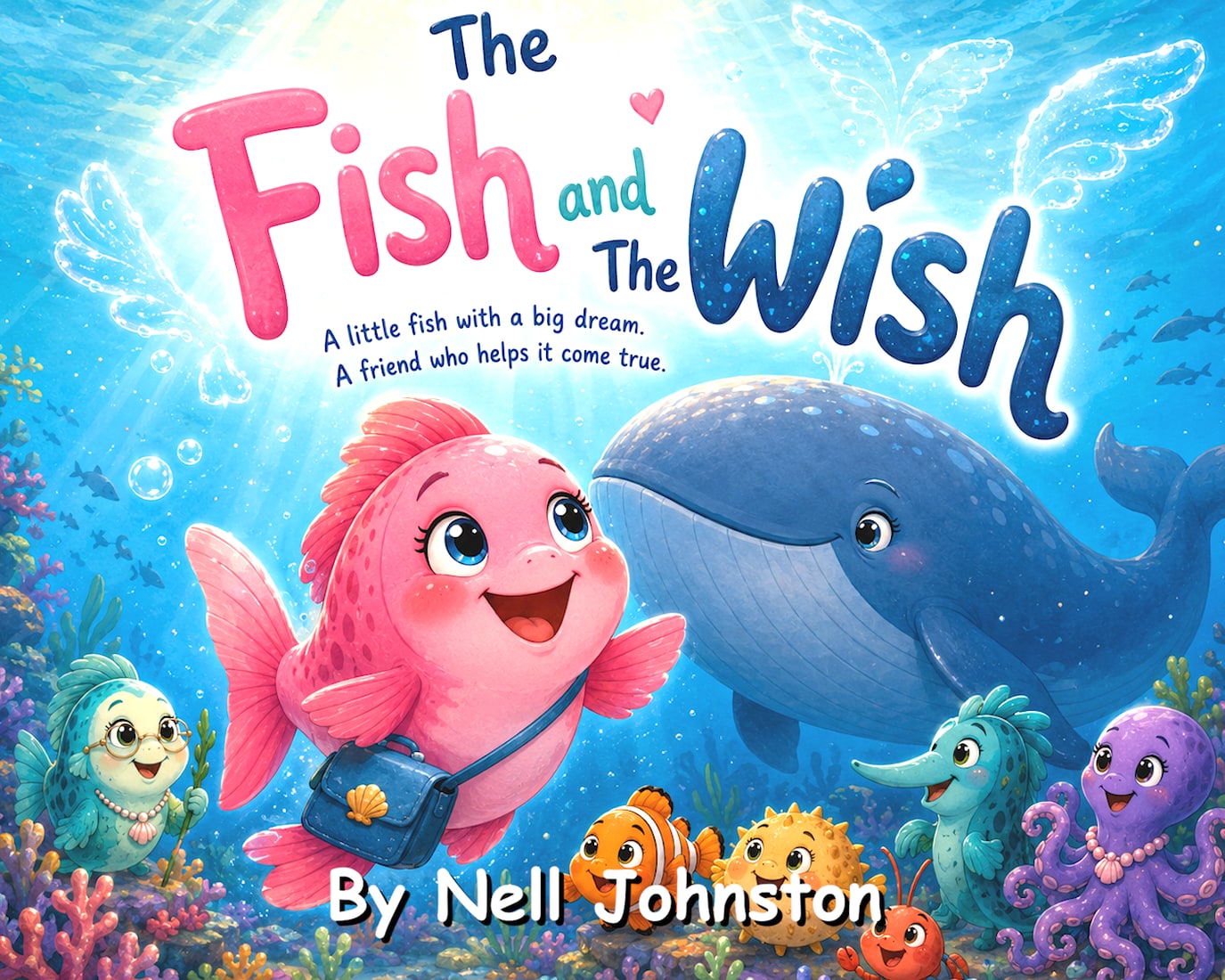
The finished Storybook film cover for Nell's story.
Figure 3. Finished Storybook visual identity. The contrast with Figure 2 shows the movement from source text to designed story world. The figure illustrates transformation, not evidence of impact.

Music adds a further ethical and aesthetic layer. Juslin and Västfjäll (2008) describe multiple mechanisms through which music can evoke emotional responses. Green and Brock's (2000) work on narrative transportation also suggests that attention, imagery and emotional involvement may draw audiences into a story world. For Storybook, music can help a story become felt; however, the same power creates responsibility. Music should amplify the author's meaning without manipulating the viewer or overwriting the story's original emotional register.

Taken together, these literatures suggest a cautious conceptual basis for Storybook: original voice matters; transformation should preserve agency; image and sound should be coherent; shared viewing may become a prompt for conversation; and the value of the artefact lies partly in what people do around it. This prepares the ground for three research pathways that give the practice a richer academic context.

Three Cardiff Met Research Pathways

North's Literature: Personhood, Reminiscence, Co-Creation and Legacy

North and Treadaway's Companion Poems work offers a significant point of comparison because it treats creative writing, sensory design, audio, touch and interactive technology as ways of supporting person-centred engagement for people living with dementia and their carers (North and Treadaway, n.d.). Companion Poems is not the same kind of practice as Storybook. It is situated in dementia-informed design and care-adjacent research, whereas Storybook is framed here as a creative storytelling practice. Nevertheless, the overlap is conceptually important.

Both practices move beyond text as static content. In Companion Poems, poetic writing is co-created and shared through tactile books, audio and sensory forms. In Storybook, a personal story may move through illustration, music, film and premiere experience. In each case, the creative object is meaningful because it carries personhood, memory, voice and relationship. The value is not only in the words but in how the words are held and returned.

North's wider creative writing background also matters here. Her published poems (North, 2025) and involvement in expressive arts education research (Griffiths et al., 2025) point towards a sensitivity to voice, authorship and meaningful arts experience. The challenge for Storybook is similar: transformation must not become replacement. A personal story can be adapted, shortened, sequenced or scored, but the process should protect what makes the story particular.

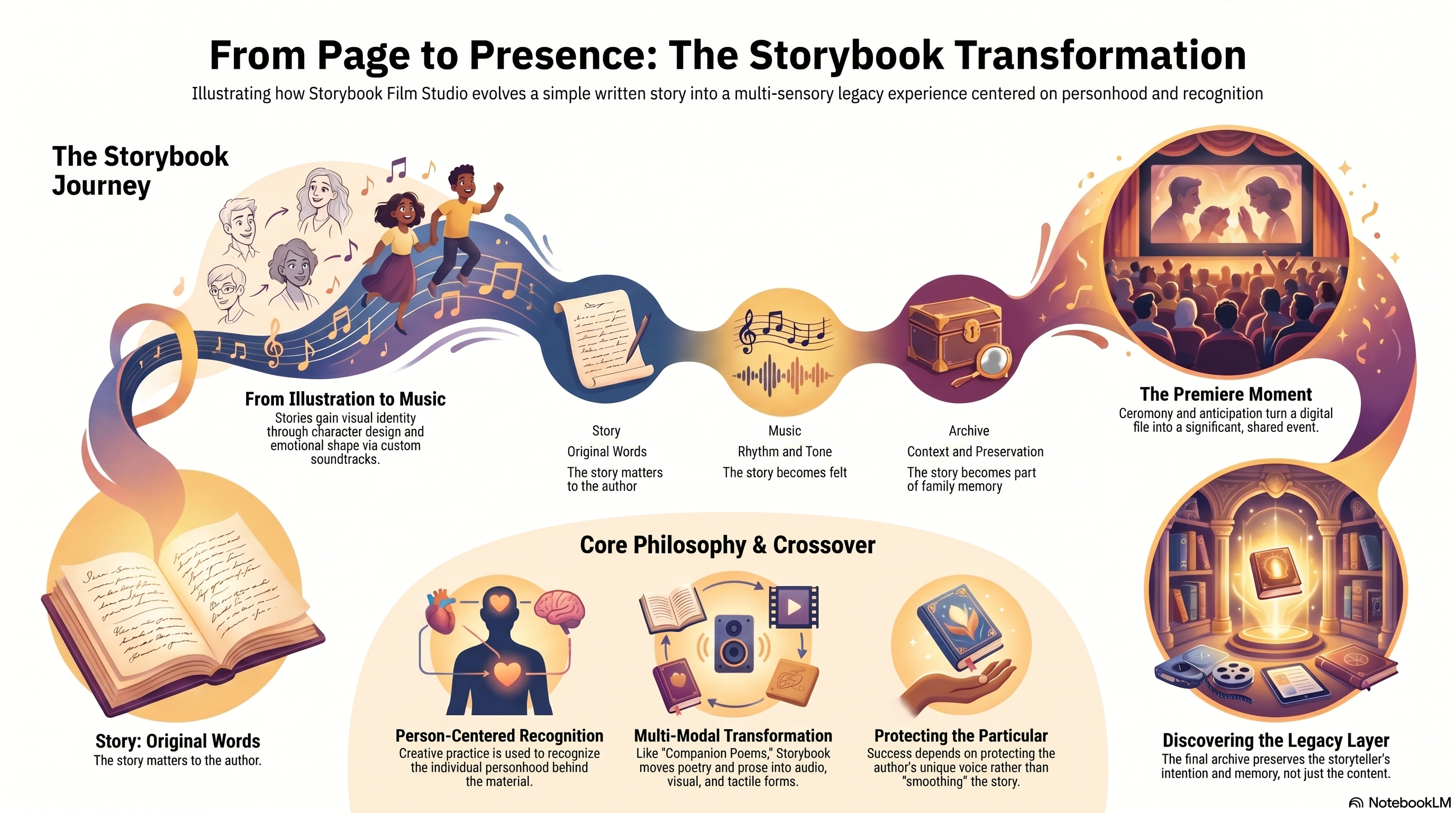
Conceptual model linking Storybook transformation with presence, personhood and legacy.
Figure 4. From Page to Presence: The Storybook Transformation. This conceptual diagram is used to articulate the connection between story transformation, multi-sensory experience, person-centred recognition and legacy. It is a discussion model, not an empirical result.

This pathway opens a possible arts-and-legacy framing. Storybook could be studied as a practice through which families encounter a story as a keepsake, memory prompt or intergenerational object. The relevant claim would not be therapeutic benefit. It would be more modest: multi-modal story transformation may create occasions for recognition, reminiscence, authorship and shared attention. Further qualitative research would be required to understand when such occasions are meaningful, when they are not, and what risks arise when personal material is transformed into public or semi-public media.

Adams' Literature: Cynefin, Place, Kairos, Animation and the More-Than-Human

Adams' work opens a different route into Storybook: not primarily legacy, but place, time, aesthetic knowing and more-than-human relation. His research on cynefin examines the Welsh word's curriculum potential through new materialist and contemplative pedagogical resonances (Adams, 2024). Adams and Jardine (2026) extend this through dialogue around place-based educational initiatives and an ontology of relations. In these terms, stories are not detached objects. They may be rooted in landscapes, language, community histories, animals, weather, local memory and the relationships through which children come to know a world.

Storybook has not yet been researched as place-based education. It should not be claimed as a cynefin intervention or ecological pedagogy. Yet Adams' literature suggests a powerful question: what happens when a child's story is not treated as a generic narrative but as something that may emerge from place, relationship and lived environment? Many children's stories already contain animals, rivers, trees, sea, weather, streets, houses, school grounds and imagined habitats. Animation and illustration can either flatten these elements into decorative backdrops or attend to them as meaningful relations.

Adams' work on art and animation of the more-than-human is especially relevant. His study of children taking part in artistic activities outdoors in natural environments reports an expanded sense of interrelationship with the more-than-human world (Adams, 2025). Adams, Smith and Beauchamp (2025) similarly explore children's woodland music-making, arguing that music-making can afford artistic or aesthetic ways of knowing. In both strands, music, art and animation are not merely outputs. They are ways of knowing, attending and relating.

The temporal dimension also matters. Adams and Harris (2024) contrast chronos, or clock-time, with kairos: a different quality of time associated with intuitive, sensory, emotional, spiritual, holistic and contemplative knowing. Storybook's premiere experience resonates with this distinction. The premiere is not simply a delivery mechanism. It is a designed pause. It marks the story as something to be attended to, anticipated and shared. Again, this is not evidence of impact, but it is a conceptual connection worth exploring.

Within a research agenda, this pathway could lead to questions about place-attuned authorship, story worlds involving more-than-human characters and the premiere as a kairotic moment of attention. A responsible formulation might be: Storybook may offer a creative context in which stories can become more visibly and audibly connected to place, relation and more-than-human imagination, provided such claims are explored rather than assumed.

Beauchamp's Literature: Music as Lived Identity, Learner Voice, Dialogue and Technology

Beauchamp and colleagues' work gives Storybook its strongest music education and dialogue pathway. Breeze, Beauchamp, Bolton and McInch (2023) describe secondary music teachers in Wales moving towards a more holistic, practical conception of music in which pupils learn through doing. John, Beauchamp, Davies and Breeze (2024) examine musical identity, pedagogy and creative dispositions among popular musicians entering teacher education, foregrounding imaginative, inquisitive and collaborative capacities. Later work on classically trained student music teachers suggests movement away from a narrow Western classical habitus towards pupil voice, shared pedagogic ownership, improvisatory teaching and tolerance of uncertainty (John et al., 2026).

This body of work is important because Storybook includes music, but the relevant question is not whether its songs are polished musical artefacts. A stronger research question is whether transforming a child's story into sound can support recognition of voice, ownership and meaning. The musical issue is not only composition quality; it is whether the child can still hear themselves in what the story has become.

Beauchamp and colleagues' work on technology and dialogue further sharpens this point. Beauchamp, Young and Major (n.d.) position technology in relation to classroom dialogue, interthinking and learner agency. Chapman and Beauchamp (2025) conceptualise interactive 360-degree images in special school settings through immersion, interaction, facilitation, novelty, autonomy, competence and relatedness. Chapman, Beauchamp and Griffiths (2024) also frame technology in expressive arts as potentially enabling access to shared creative processes.

For Storybook, these ideas create a useful caution. Technology should not be the claim. If the practice is researchable, it is because technology may help initiate, support or preserve dialogue around a story. It may make a story visible, audible and shareable, but the meaningful unit is still the relationship between source text, author, creative decisions and audience response.

Character continuity guide showing how a story character is developed for film.
Figure 5. Character continuity as translation between page and film. This process image illustrates the kind of practical making through which a story becomes visually coherent, recognisable and discussable.

This pathway suggests that Storybook could be examined through questions of musical identity, learner voice, shared ownership and dialogic reflection. How do children talk about a story after hearing it as a song? What choices feel still theirs? What does music add or risk? How do adults avoid over-polishing? How does technology help without becoming the centre of the experience?

Synthesis Model: Page -> Image -> Sound -> Film -> Premiere -> Archive/Reflection

The three pathways converge around a common transformation sequence. Storybook begins with a page or source story. That story is interpreted visually, musically and cinematically. It is then returned through a viewing moment and, potentially, preserved as an archive or prompt for later reflection.

Page source story and authorship Image visual identity and continuity Sound music, rhythm and tone Film sequence, pacing and movement Premiere shared attention and recognition Archive return, memory and reflection

This model is deliberately descriptive rather than causal. It does not claim that moving through these stages improves literacy, wellbeing, musical learning, ecological awareness or family connection. It proposes that each stage adds an experiential change that can be studied.

The page anchors authorship. Image gives form and continuity. Sound gives rhythm, mood and affective contour. Film creates sequence and watchability. Premiere creates a social and temporal frame for attention. Archive or reflection allows return. At each point, there is both possibility and risk. The story can be honoured or distorted; the author can be recognised or overwritten; music can support feeling or manipulate it; technology can enable access or become spectacle.

Nell's story map from the Storybook process.
Figure 6. A story map from the Storybook process. The figure illustrates an intermediate design layer between original writing and finished film: a place where characters, sequence and emotional movement can be made explicit.

The synthesis is therefore not a workflow alone. It is an ethical and researchable structure. North's literature asks whether transformation can preserve personhood and memory. Adams' literature asks whether story can remain related to place, time and more-than-human worlds. Beauchamp's literature asks whether music, technology and dialogue can sustain learner voice and creative ownership. Storybook sits at the intersection of these questions.

Research Agenda

A first research agenda should be qualitative, exploratory and practice-led. The appropriate question is not "does Storybook work?" but "how is Storybook experienced, interpreted and ethically negotiated by authors, families, children, educators or viewers?" The difference matters. At this stage, Storybook should be studied as a creative practice, not evaluated as a proven intervention.

One possible design would be a small qualitative case study series involving three to five Storybook projects. Data sources might include original stories, adaptation notes, visual and musical decision logs, finished films, premiere pages, post-viewing reflections and optional follow-up conversations. Where children are involved, child assent, parental consent, privacy and right of withdrawal would be central. Where older adults or family legacy stories are involved, the ethics of representation, consent and archive access would require careful attention.

Practice-led inquiry would allow the creative process itself to become data. How are characters interpreted? What is preserved from the original text? What is changed for pacing or clarity? How is music chosen? What does the author or family recognise in the finished version? Such questions fit a reflective practitioner model in which making and thinking are intertwined (Schön, 1983).

Participatory arts research could also be appropriate, particularly if the process were adapted for schools, families or community settings. In such cases, the research should foreground participant voice rather than merely showcasing finished artefacts. Children might be invited to reflect on which parts of the transformed story still feel like theirs; families might discuss how the premiere changed their conversation about the story; teachers might comment on the role of dialogue and creative ownership.

Reflexive thematic analysis would provide one way to examine qualitative data across cases. Initial themes might include authorship, recognition, story ownership, musical meaning, visual identity, family memory, place relation, more-than-human imagination, technology as tool, over-polishing, misrecognition and emotional response. These themes should remain open to revision rather than imposed in advance.

A more ambitious later phase might test specific adaptations: a "From Page to Presence" family legacy study; a "From Page to Place" school/place-based storytelling study; or a "From Story to Sound" music and learner-voice study. However, these should follow, not precede, careful exploratory work.

Ethics and Boundaries

The ethical boundaries are central to the paper. Storybook should not claim to be therapy, a curriculum intervention, a wellbeing intervention, an ecological intervention or a music education intervention. Research by Fancourt and Finn (2019) shows broad links between arts engagement and health or wellbeing across varied contexts, and Woods et al. (2018) review reminiscence therapy for dementia, but these literatures do not validate a story film practice as a health intervention. Similarly, music education, multimedia learning and place-based pedagogy literatures can inform Storybook's design questions without proving learning outcomes.

Several risks follow from the very strengths of the practice. First, personal stories can be over-shaped. A film can become more polished while becoming less true. Second, children's stories can be adult-edited into conventional narratives that erase their strangeness, humour or idiosyncratic logic. Third, music can overpower meaning. Fourth, visuals can make a story attractive while narrowing interpretation. Fifth, public or semi-public sharing can create privacy, safeguarding and consent issues. Sixth, archive language can imply permanence without sufficient clarity about access, control and withdrawal.

The careful claim is that multi-modal story transformation may create meaningful experiences of authorship, recognition and shared attention in some contexts. The research task is to understand when, how, for whom and with what risks.

Ethical practice would therefore require:

  • clear consent and, where relevant, child assent;
  • transparency about creative adaptation;
  • protection of the original story and authorial intention;
  • options for private viewing and withdrawal before publication;
  • careful handling of names, images, voices and family details;
  • avoidance of unsupported claims;
  • reflective documentation of creative decisions;
  • participant opportunity to respond to the transformed artefact.

These boundaries do not weaken Storybook's research potential. They make it more credible.

Conclusion

Storybook Film Studio began from a small creative question about illustrating a child's story. Its development into music, film, premiere and archive suggests a richer research-adjacent practice concerned with how stories move across media and social contexts. When placed alongside research on person-centred creative practice, cynefin and place, more-than-human pedagogy, music education, learner voice, digital storytelling and multimedia coherence, Storybook becomes a site of inquiry.

The central contribution of this position paper is not an evidence claim but a framing. Storybook can be understood as a multi-modal practice of story transformation in which the original page is not discarded but carried through image, sound, film, shared viewing and return. Its promise lies in recognition; its risk lies in overclaiming or overwriting. Its strongest future is therefore not as a finished intervention but as a carefully documented creative practice open to collaborative research.

The bridge proposed here is modest but potentially generative. Storybook may offer a way to ask how stories become visible, audible, place-attuned, person-centred, musically felt and socially shared. The appropriate next step is not to prove value too quickly, but to study the process carefully enough that its value, limits and ethical demands can be understood.

Appendix: AI-Assisted Co-Construction, Lived Experience and Source Validation

This paper was developed through an AI-assisted co-construction process. The use of AI was not incidental to the paper's argument. It reflects the same creative and methodological logic through which Storybook itself came into being: a lived experience or source story is brought into dialogue with generative tools, then shaped through human judgement, ethical constraint, reflection and return.

In this sense, AI acted as a co-authoring partner in the generation of the paper: not as an accountable academic author, but as a dialogic collaborator in synthesis, structure, drafting, comparison and revision. Human authorship remained responsible for the originating experience, the interpretation of Storybook's development, the ethical stance, the decision to include or exclude claims, and the final validation of the text.

Storybook began with a simple human question: could a child's story be given illustrations? That question became a wider practice because the process revealed something that was not visible at the start. Image, music, film and premiere did not replace the original story; they made it newly perceptible. In a similar way, AI was used in the development of this paper as a form of intelligence amplification: to help organise a large body of local research material, identify conceptual overlaps, test possible framings, draft alternative phrasings, and make visible connections between Storybook's lived creative journey and adjacent academic literatures.

The paper should therefore be understood as AI-assisted research documenting a lived practice, rather than as a detached AI-generated literature review. The originating insight, research purpose, Storybook process knowledge, ethical boundaries and final direction remained human-led. AI contributed by helping to hold multiple strands in view at once: family story, authorship, music, image, place, personhood, learner voice, sensory design and academic citation. This mirrors the paper's own argument that technology is most valuable when it supports recognition and dialogue rather than becoming the object of attention.

For scientific accountability, cited claims were cross-checked against the available source papers rather than accepted from generated summary. The Cardiff Met research pathway claims were reviewed against the local articles and manuscripts held in the Kate North, Dylan Adams and Gary Beauchamp folders. This included checking the Companion Poems manuscript for claims about poetic writing, dementia, co-creation, audio, tactile and sensory design; Adams' papers for claims about cynefin, kairos, place, animation, woodland music-making and the more-than-human; and Beauchamp and colleagues' papers for claims about music education, learner voice, creative dispositions, dialogue, technology and curriculum reform. Where external conceptual sources were used, bibliographic details and high-level claims were checked against available DOI or publisher metadata where possible.

The role of AI in this paper was therefore bounded in five ways:

  • AI supported synthesis, drafting, comparison and visual/conceptual organisation.
  • AI did not replace human responsibility for interpretation, ethics or final claims.
  • Claims about Storybook were framed as exploratory and practice-led, not empirically proven.
  • Claims about cited research were limited to what the reviewed papers could support.
  • The resulting text was treated as a co-constructed research artefact requiring human review, source validation and future empirical study.

This appendix is included to make the research process visible. It also acknowledges that the method of writing the paper is connected to its subject. Storybook asks what happens when lived stories are transformed through careful human-AI collaboration into image, sound, film and shared attention. This paper asks a parallel question: what happens when lived creative practice is transformed through careful human-AI collaboration into an academic argument? In both cases, the ethical test is whether the source remains recognisable.

References

Adams, D. (2024) 'Exploring the curriculum potential of the Welsh word cynefin by examining its new materialist and contemplative pedagogical resonances', Journal of Contemplative and Holistic Education, 2(2), Article 1. doi: 10.25035/jche.02.02.01.

Adams, D. (2025) 'Art and animation of the more-than-human: an investigation into the experiences of children, aged 7-11 years old, taking part in artistic activities outdoors in natural environments', Journal of Adventure Education and Outdoor Learning. doi: 10.1080/14729679.2025.2593838.

Adams, D. and Harris, S. (2024) 'Pathways to Kairos: Exploring the ontological, pedagogical, and ecological implications of escaping the clutches of Chronos', Cultural and Pedagogical Inquiry, 16(2), pp. 40-54.

Adams, D. and Jardine, D. (2026) 'New place-based educational initiatives in the Welsh curriculum and some legacies of the Canadian experience: a conversation', Journal of Philosophy of Education, 60, pp. 45-71. doi: 10.1093/jopedu/qhaf053.

Adams, D., Lewis, R. and Haughton, C. (n.d.) 'Bee-ing and feeling of place'. In Arts in Nature with Children and Young People. doi: 10.4324/9781003386162-3.

Adams, D., Smith, K. and Beauchamp, G. (2025) '"Wild" music-making: an investigation into the experiences of children (aged 7-10) when music-making in a woodland', Education 3-13, 53(5), pp. 693-704. doi: 10.1080/03004279.2025.2485272.

Archibald, M. and Kitson, A. (2019) 'Using the arts for awareness, communication and knowledge translation in older adulthood: a scoping review', Arts & Health. doi: 10.1080/17533015.2019.1608567.

Beauchamp, G. and Gear, R. (2023) 'ASPE: a too well-kept secret?', Education 3-13, 51(8), pp. 1211-1213. doi: 10.1080/03004279.2023.2252248.

Beauchamp, G., Breeze, T., John, V. and MacGregor, E.H. (2026) 'Forty years of the General Certificate of Secondary Education: analysing the role of the performing-composing-appraising examination structure in secondary music education in England, Wales, and Northern Ireland', British Journal of Music Education, pp. 1-14. doi: 10.1017/S0265051726100849.

Beauchamp, G., Young, N. and Major, L. (n.d.) 'Technology and dialogue in the primary classroom'. doi: 10.4324/9781003408925-8.

Breeze, T., Beauchamp, G., Bolton, N. and McInch, A. (2023) 'Secondary music teachers: a case study at a time of education reform in Wales', Music Education Research, 25(1), pp. 49-59. doi: 10.1080/14613808.2022.2128320.

Chapman, S. and Beauchamp, G. (2025) 'A tripartite conceptualisation of the pedagogic use of interactive 360 degree images in a special school setting: practitioners' perceptions of using 360 degree technologies with learners aged 7-11 years', TechTrends, 69, pp. 672-683. doi: 10.1007/s11528-025-01069-x.

Chapman, S., Beauchamp, G. and Griffiths, M. (2024) 'Secondary school teachers' perceptions of the shared creative processes and the potential role of technology in the expressive arts', The Curriculum Journal. doi: 10.1002/curj.259.

Clark, J. and Paivio, A. (1991) 'Dual coding theory and education', Educational Psychology Review, 3(3), pp. 149-210. doi: 10.1007/BF01320076.

Fancourt, D. and Finn, S. (2019) What is the evidence on the role of the arts in improving health and well-being? Copenhagen: WHO Regional Office for Europe.

Fivush, R. (2011) 'The development of autobiographical memory', Annual Review of Psychology, 62, pp. 559-582. doi: 10.1146/annurev.psych.121208.131702.

Green, M.C. and Brock, T.C. (2000) 'The role of transportation in the persuasiveness of public narratives', Journal of Personality and Social Psychology, 79(5), pp. 701-721. doi: 10.1037/0022-3514.79.5.701.

Griffiths, M., Oliver, E., Hewage, C., North, K. and Pigott, J. (2025) 'Where is the "New"? Teachers' perceptions of the opportunities and challenges for the Expressive Arts AoLE in the Curriculum for Wales (2022)', Wales Journal of Education, 27(1). doi: 10.16922/wje.27.1.3.

Hardy, P. and Sumner, T. (2014) Cultivating compassion: how digital storytelling is transforming healthcare. Basingstoke: Palgrave Macmillan. doi: 10.1057/9781137379655.

John, V., Beauchamp, G., Davies, D. and Breeze, T. (2024) 'Musical identity, pedagogy, and creative dispositions: exploring the experiences of popular musicians during their postgraduate teacher education in a changing Welsh education landscape', Research Studies in Music Education, 46(3), pp. 516-528. doi: 10.1177/1321103X241241980.

John, V., Beauchamp, G., Davies, D. and Breeze, T. (2026) 'Moving away from the habitus? Narrative accounts from classically trained student secondary school music teachers in Wales', British Journal of Music Education, pp. 1-14. doi: 10.1017/S0265051725100661.

Juslin, P.N. and Västfjäll, D. (2008) 'Emotional responses to music: the need to consider underlying mechanisms', Behavioral and Brain Sciences, 31(5), pp. 559-575. doi: 10.1017/S0140525X08005293.

Kucirkova, N. (2019) 'Children's agency by design: design parameters for personalization in story-making apps', International Journal of Child-Computer Interaction, 21, pp. 112-120. doi: 10.1016/j.ijcci.2019.06.003.

Mayer, R.E. and Moreno, R. (2003) 'Nine ways to reduce cognitive load in multimedia learning', Educational Psychologist, 38(1), pp. 43-52. doi: 10.1207/S15326985EP3801_6.

McAdams, D.P. (2001) 'The psychology of life stories', Review of General Psychology, 5(2), pp. 100-122. doi: 10.1037/1089-2680.5.2.100.

North, K. (2025) 'Three poems', New Writing, 22(1), pp. 89-92. doi: 10.1080/14790726.2025.2455695.

North, K. and Treadaway, C. (n.d.) 'Creating and sharing Companion Poems for people living with dementia, a design journey'. Author accepted manuscript.

Pajares, F. and Valiante, G. (1997) 'Influence of self-efficacy on elementary students' writing', The Journal of Educational Research, 90(6), pp. 353-360. doi: 10.1080/00220671.1997.10544593.

Pugh, C. et al. (2020) 'Perceptions of the new role of the Research Champion in developing a new ITE partnership: challenges and opportunities for schools and universities', Wales Journal of Education, 22(1). doi: 10.16922/wje.22.1.9.

Schön, D.A. (1983) The reflective practitioner: how professionals think in action. New York: Basic Books.

Takacs, Z.K., Swart, E.K. and Bus, A.G. (2015) 'Benefits and pitfalls of multimedia and interactive features in technology-enhanced storybooks: a meta-analysis', Review of Educational Research, 85(4), pp. 698-739. doi: 10.3102/0034654314566989.

Woods, B. et al. (2018) 'Reminiscence therapy for dementia', Cochrane Database of Systematic Reviews. doi: 10.1002/14651858.CD001120.pub3.